兩聲道
CD機 | MD機 | SACD機 | DAC | CAS | 合拼擴音機 | 前級擴音機 | 後級擴音機 | 接線 | 喇叭線 | 揚聲器 | 耳機 | 耳機擴音機 | LP產品 | 膽機產品 | 開卷式錄音機 | 音響配件 | DIY音響 | 電源 | 家庭影院
電視機 | 投影機 | 錄影機 | DVD影碟機 | Blu-ray影碟機 | 多媒體播放器 | 機頂盒 | 多聲道擴音機 | 多聲道揚聲器 | 多聲道影音組合 | Mini音響組合 | 重低音揚聲器 | 輔助設備 | 同好會
同好會 | Accuphase | B&W | Burmester | Denon | Jadis | KEF | KRELL | Luxman | Marantz | Nuforce | OPPO | Pioneer | TEAC | WEISS | News
News | Blog | 其他
其他 | 所有 |
| 影音天地主旨 ﹝請按主旨作出回應﹞ 上頁 下頁 首頁 尾頁 | 寄件者 | 傳送日期
|
| [#9422] 把音樂留給了想像的—薩提 @ 陳韻琳 當薩提在音樂學院學音樂的時候,他的老師都說他很懶,老實說我很同意他的老師的評語,他的老師一定對他又愛又恨,因為薩提從來不打算發展他的樂念,不想組織他的形式,就像一個很有思想的人不想組織形式成為一篇論文;而偉大的藝術家,再有天分,還是得花上他無數的晝夜拼上他全部的努力才行。 但是薩提的樂念真的是獨樹一格。怎麼說呢?我身邊有非常多喜歡唸書酷愛文學的人,但他們不愛聽古典音樂,但薩提卻能成為一座橋,讓文學與音樂構成一種對話,於是我酷愛文學的好朋友們,都從薩提的音樂進入到古典音樂的殿堂。 舉例來說吧,我曾經在播放薩提的「三首歪斜舞」和「三首逃跑的歌」時,讓我的好朋友忍不住朗誦起羅門的詩「流浪人」: 被海的遼闊整得好累的一條船在港 他用燈栓自己的影子在咖啡桌的旁邊 那是他隨身帶的一條動物 除了它 娜娜近得比什麼都遠 把酒喝成故鄉的月色 空酒瓶望成一座荒島 他帶著隨身帶的那條動物 朝自己的鞋聲走去 一顆星也在很遠很遠 帶著天空在走 明天 當第一扇百葉窗 將太陽拉成一把梯子 他不知往上走 還是往下走 我問朋友薩提這幾首曲子跟羅門這首詩有怎樣的關係呢?我朋友說:「就是一種清冷與孤寂,一種不知道從哪堥荂B又不知道會走向何方的感覺。」 或麻譬ㄣN是想捕捉一種氣氛、一種感覺,他並不打算言之成理言之有物,但他也不打算煽情,外加他孤傲孤僻的個性,音樂總是多了這些清冷和孤寂,於是音樂在起始和終結之際,好像中國潑墨山水,留了白,增添了釵h想像的空間。 薩提這一輩子只向一個女人求過婚,這女人是一個名女人,她漂亮到畫家都想拿他做模特兒,印象派畫家雷諾瓦和狄嘉都畫過她,狄嘉甚至發現了這個女人有繪畫的天分,鼓勵她成為畫家,這女人名叫蘇珊•瓦拉登(Suzanne Valadon)。蘇珊是一個不喜歡安定下來的女人,她四海為家流浪天涯、不被任何一個男人收編,甚至曾經有一個比她大很多歲的男人,在她已經有了孩子以後願意明媒正娶,給孩子一個正當的姓,蘇珊卻在三年以後帶著孩子離開了她。 蘇珊放浪形骸並且酗酒,她的這種生活使她的孩子尤特里羅深深的受苦,因為尤特里羅在十歲的時候也開始酗酒,可是蘇珊也把繪畫的天賦遺傳給了孩子,造就了一代酗酒繪畫大師尤特里羅。我們從尤特里羅這麼酷愛畫教堂可以看出尤特里羅心靈深處的苦惱,他渴望被拯救,而他畫中的教堂總是清冷孤絕傲然遺世在天地之間,寂寞但是美麗。被酗酒所苦的尤特里羅,類似他母親的命運,遇到了一個比他很多歲的女人,但他跟他母親做了不一樣的選擇,他選擇跟那女人結婚安定下來,他戒了酒,但這安定也使他從此平凡,他的畫開始庸俗不堪。(在電影《莫迪里亞尼與畢卡索》中,有一部分劇情刻畫了尤特里羅跟莫迪里亞尼一起鬼混、被母親送進療養院的生平。) 再回到薩提向蘇珊求婚一事,那時蘇珊還年輕,當然是不會答應的,但薩提在這一次受挫之後,從此便斷了向女人求婚的念頭。可是薩提這一生,卻跟蘇珊和他的兒子尤特里羅命運類似,都是酗酒而寧願孤獨的,蘇珊不肯被男人收編,正像薩提不願被音樂形式收編一樣,他們都知道美是什麼,可是卻在流浪的心靈中,似乎是浪費了美。 我們看他的Gymnopedie舞曲,他的創意以及對感覺的捕捉簡直是出神入化,我認為關鍵不是在希臘調式的旋律,而是搭配這個調式和旋律的節奏,這節奏其實是單調、穩定、不發展變化的,卻把樂念襯托成清冷和孤寂。這本應是一種祭典儀式,是一種裸體少年舉行的舞蹈風競技遊戲,這本來應當是熱鬧繁華的,薩提卻將它從本質上就做了改變。 薩提只能是薩提,只有他能將他自己的樂念,發展成為管弦樂,偏偏他懶惰,而後世任何改編他曲目的人,一旦想把樂器增多,味道就變了,就像跟老女人結婚的尤特里羅,變得庸俗不堪。 聽薩提的音樂還有個講究,就是得要注意他的標題,他的標題跟樂念密切相關的,文學風格很強,像詩句、甚至是一首諷刺的詩。我想,正因為是這樣,我那些喜愛文學的朋友,都覺得薩提不難,因為薩提把音樂留給了文學的想像。 看著二十世紀後來音樂的發展,薩提竟像是一個先知先覺者,他不讓音樂形式占滿他的樂念,讓留白與想像,在音樂之外發展,於是他的音樂可以成為總體藝術的一環,搭以舞蹈或戲劇或文學,讓各個藝術各自站著自己的位置,一起創造了元素更多元的總體藝術,電影配樂不就是這麼來的嗎? 薩提絕不是一個偉大的藝術家,但是在音樂史上頭不能少了他,而且,他的風格也很難被取代。 http://blog.chinatimes.com/gospel/archive/2008/09/25/326957.html  |
george1977 正式會員 正式會員61.xxx.xxx.107 |
2008-12-10 18:55 | |
|
|
|||
| [#9423] 把音樂留給了想像的—薩提 @ 陳韻琳 以下是一張歷史性照片,戴帽子的是畢卡索,這些人正坐在畢卡索為薩提芭蕾《遊行》畫的劇幕畫上。 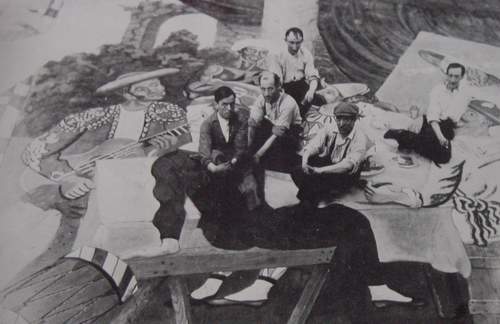 |
george1977 正式會員 61.xxx.xxx.107 |
2008-12-10 18:56 |
| [#9424] Tchaikovsky 1812 overture version analysis http://blog.udn.com/janwindward/2365932 |
george1977 正式會員 61.xxx.xxx.107 |
2008-12-13 15:04 |
| [#9425] MERCURY Living Presence SACD Reissue http://music.u-audio.com.tw/musicdetail.asp?musicid=124 http://music.u-audio.com.tw/musicdetail.asp?musicid=125 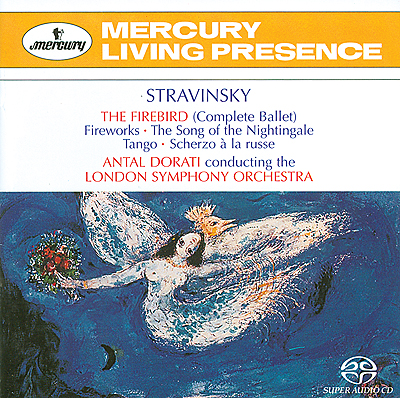 |
george1977 正式會員 61.xxx.xxx.107 |
2008-12-13 15:08 |
| [#9426] Bruno Walter 的馬勒《巨人》 戰後的倫敦愛樂 (LPO),與眾指揮名家有過釵h錄音,唯獨鮮少和 Bruno Walter 合作,另一個演出,是同年同月在倫敦皇家亞伯廳(Royal Albert Hall)登場的貝多芬第九號交響曲。 Bruno Walter 的馬勒《巨人》第8個錄音版本(2次錄音室+5次實況),將在Testament現身,這個錄於1947年11月的廣播版本,Walter 指揮的樂團是倫敦愛樂,過去一直被列為 Walter 未出版的廣播錄音,如今這個傳說中的演出,終於正式發行商業唱片。  |
george1977 正式會員 61.xxx.xxx.107 |
2008-12-13 15:17 |
| [#9427] 【MDG巴哈鋼琴四手聯彈改編曲】完美的錄音與正統德國風格 3 http://www.my-hiend.com/vbb/showthread.php?t=1126  |
george1977 正式會員 61.xxx.xxx.107 |
2008-12-13 22:39 |
| [#9428] 【MDG巴哈鋼琴四手聯彈改編曲】完美的錄音與正統德國風格 2  |
george1977 正式會員 61.xxx.xxx.107 |
2008-12-13 22:40 |
| [#9429] 【MDG巴哈鋼琴四手聯彈改編曲】完美的錄音與正統德國風格 1 http://www.my-hiend.com/vbb/showthread.php?t=1126  |
george1977 正式會員 61.xxx.xxx.107 |
2008-12-13 22:41 |
| [#9430] A Centennial Moment for a Mahler Epic By STEVE SMITH Published: December 9, 2008 Amid the myriad festivities cramming the calendar this year, the milestone observed by the New York Philharmonic on Monday night might easily have been overlooked. On Dec. 8, 1908, Mahler conducted the New York Symphony, a precursor to the Philharmonic, in the American premiere of his Symphony No. 2 (“Resurrection”). Exactly one century later, Gilbert Kaplan conducted the Philharmonic in the work at Avery Fisher Hall. Mr. Kaplan’s story has attracted attention well beyond the classical music world. As a young economist in 1965, he fell under the spell of this epic work. Mr. Kaplan pursued his passion to an extraordinary extent: after a crash course in conducting, he went on to lead high-profile performances of the symphony and made the all-time best-selling Mahler recording. His reputation as the world’s leading “Resurrection” authority clearly precedes him; the hall was full on Monday. That Mr. Kaplan is no professional conductor was immediately apparent. Square-shouldered and stiff, he indulged in no flamboyant gymnastics. He conducted from memory, beating time proficiently and providing cues as needed. Only in a few passages, like the pages of heavenly bliss just before the first movement’s tempo-sostenuto conclusion, did a curl of the lip suggest that he was swept up in his work. But his efforts were evident throughout a performance of sharp definition and shattering power. From the acute punch of the opening notes, every detail of this huge, complex score came through with unusual clarity and impeccable balance. Every gesture had purpose and impact, and the performance as a whole had an inexorable sweep. The orchestra played with astonishing control and beauty. Janina Baechle, a mezzo-soprano, sang with rich tone and an understated intensity; Esther Heideman, a soprano who replaced the ill Christiane Oelze, was sweet and shimmering in the finale. The Westminster Symphonic Choir sounded glorious. To think there is nothing else to know of Mahler’s Second beyond what Mr. Kaplan has to show would be a mistake. But it seems likely that no one is better equipped to reveal the impact of precisely what Mahler put on the page. http://www.nytimes.com/2008/12/10/arts/music/10kapl.html?ref=music  |
george1977 正式會員 61.xxx.xxx.107 |
2008-12-14 00:01 |
| [#9431] Reimagining Mahler as He Imagined It By MATTHEW GUREWITSCH Published: December 5, 2008 GUSTAV MAHLER’S “Resurrection” Symphony, officially his Symphony No. 2 in C minor, traces a spiritual arc from tempestuous mourning though bittersweet reminiscence and churning despair to a place of transcendent bliss. The single step with which the cosmic journey begins is a four-beat bar for the violins and violas, quivering in octaves on the note G. Skip to next paragraph Multimedia 'Wieder sehr breit,' from 'Resurrection,' performed by Gilbert Kaplan Kaplan Foundation Collection Gustav Mahler, Mr. Kaplan’s inspiration. Most conductors attack with a crash. Gilbert E. Kaplan wants to hear a whoosh, like a huge wave. If a concertmaster demurs because the strings have always played the bar the other way, Mr. Kaplan offers a simple proposition: “Well, why don’t we do it the way Mahler wrote it?” The dynamic marking is fortissimo (very loud), tapering to a tremulous piano (soft). Mahler annotated his scores in compulsive detail, often tinkering with them for years. He placed no accent at the start of the opening note, Mr. Kaplan observes, so why play one? “When people don’t do things that are in the score or vice versa,” Mr. Kaplan said recently, “I always wonder: Is it because they don’t like the way it is written, which would indicate that they are taking license, as they’re entitled to do? Or don’t they know?” On Monday evening Mr. Kaplan, 67, makes his New York Philharmonic debut in a concert celebrating the centennial of the American premiere of the Mahler Second, joining the orchestra’s line of distinguished interpreters from Lorin Maazel, Zubin Mehta, Leonard Bernstein, James Levine, Bruno Walter, Artur Rodzinski, Otto Klemperer and Willem Mengelberg back to Mahler himself. Before the performance he will also host a free multimedia presentation, “Mahler’s New York Adventure.” One afternoon in November Mr. Kaplan was at home on upper Fifth Avenue discussing his favorite subject. Having made his fortune at an early age as the founder of the magazine Institutional Investor, he first stepped out as a maestro, in 1982, with a performance he expected to be his last. The 90-minute “Resurrection” Symphony had been a fixation with him since he first encountered it in 1965, as a young economist working at the American Stock Exchange. “I felt like a bolt of lightning had gone through me,” he has said. “The music just seemed to wrap its arms around me and never let go.” With no more musical training than the three years of piano lessons he had taken as a boy, he woke up one morning at 40 certain that he would conduct it. In a tour de force that at the time could be regarded as a rich man’s self-indulgence if not an outright folly, he spent seven months coaching privately with Charles Zachary Bornstein, a recent graduate of the Juilliard School, whom he called “the most extraordinary teacher I’ve had of anything.” In addition he sought pointers and advice from a host of seasoned Mahlerians, including the crusty Georg Solti, whose skepticism he overcame in an intensive two-hour session in London. Thus prepared, Mr. Kaplan hired the American Symphony Orchestra, the Westminster Choir and the vocal soloists Birgit Finnila and Carole Farley; booked Avery Fisher Hall; and packed the house with invited global financiers, in town for a meeting of the International Monetary Fund. The few music critics who attended had pledged not to review, but Leighton Kerner, of The Village Voice, heralded the performance in print as “one of the five or six most profoundly realized Mahler Seconds” he had heard in a quarter century. Since that improbable debut Mr. Kaplan has established himself as arguably the world’s foremost living authority on the Mahler Second. He owns the manuscript and is, with Renate Stark-Voit, co-editor of the new critical edition (published by Universal Edition), which the International Gustav Mahler Society in Vienna has designated the official score. He has recorded the work twice, in 1987 with the London Symphony Orchestra and in 2002 with the Vienna Philharmonic. The London Symphony version is the best-selling Mahler recording in history, having sold more than 180,000 copies; the Vienna Philharmonic version, the premiere recording of the new critical edition, is a best seller in its own right, with sales approaching 40,000. Clive Gillinson, now the executive and artistic director of Carnegie Hall, was in the cello section when Mr. Kaplan gave his first performance with the London Symphony at his own expense in 1984. “It was a monumental success,” Mr. Gillinson said last week. “By the time he wanted to record it, I was the manager of the orchestra. We recommended an audio engineer, and together they traveled around the U.K. trying out halls. That’s typical. With Gil, everything has to be exactly right.” At the New York Philharmonic Mr. Kaplan will provide his own bells. By now he has performed the Mahler Second about 100 times with 57 orchestras, the New York Philharmonic being the 58th. He has also recorded the Adagietto from Mahler’s Fifth Symphony, but he conducts nothing else. Most reviews have been ecstatic, peppered with adjectives like “shattering,” “sensational” and “uplifting,” though he has also taken a drubbing or two. “One London reviewer said he could not wait to get out of the hall to listen to the buskers, the street musicians,” Mr. Kaplan said. “I think that was political. But the wonderful thing in London is that you get three or four notices, not just one.” Mr. Kaplan has no agent and no apparent need of one. Invitations keep coming in, from institutions both starry and obscure. He has conducted student orchestras but also opened the prestigious Salzburg Festival in Austria, and he presented the Chinese premiere of the symphony in Beijing. Farther afield he has appeared in Melbourne and even Novosibirsk, in remotest Russia. The Stark-Voit/Kaplan edition of the Second, which supersedes the critical edition by Erwin Ratz, includes more than 500 changes and corrections, based not only on Mahler’s hand-corrected copy of the printed score (unknown to Ratz) but also on more than a dozen other widely scattered sources. “Most of the differences the audience will never hear,” Mr. Kaplan said. “But a performer ought to have the piece as the composer left it. I don’t want to go into the question: Is the composer always right?” “When Mahler came to the Vienna State Opera as a conductor,” Mr. Kaplan added, “a musician with 40 years experience said: ‘It’s amazing! He expects us to play everything in our parts.’ Now it’s true that you won’t get a great performance of Mahler’s Second just from following his thousands of details. But his secret as a conductor was that he could express feelings better than anyone. And his markings of expression show you how to do that.” Skip to next paragraph Enlarge This Image Tanja Niemann Mr. Kaplan recording with the Vienna Philharmonic. Multimedia 'Wieder sehr breit,' from 'Resurrection,' performed by Gilbert Kaplan Scrupulous to a fault, Mr. Kaplan has annotated a conspicuous note for the timpanist. “It looks wrong, sounds wrong and people think it cannot possibly be right,” Mr. Kaplan said. “Almost everyone changes it. But Mahler saw it. He heard it, and never changed it.” The “wrong” note has been preserved, with an emphatic footnote. Another curious passage involves strumming the upper string instruments like guitars instead of plucking them. “Mahler put the direction in the score, then he crossed it out,” Mr. Kaplan said. Rather than imitate guitar technique, he usually leaves the sound of the guitar in the realm of poetic suggestion, though he reserves the right to change his mind. Apart from all the data Mr. Kaplan has amassed since 1982, how much has his imagination grown? Fundamentally, he said, there have been no more grand epiphanies. “The intensity with which I studied the score the first time makes epiphanies unlikely, and they haven’t occurred,” he said. “What I have learned is how different one performance is from another, though you didn’t intend it to be. It all depends on the mood of the night. I’ve learned to go with my instinct, not to shut it down.” Still, experience tells. The first moments of the Vienna Philharmonic recording, beginning with that mighty whoosh, lay claim to the music as the earlier recording with the London Symphony never does. For vibrancy and intensity of tone, for emotional specificity, variety of color and sense of direction, from the threshold of silence to the most volcanic eruptions, the Vienna performance justifies the sort of critical rapture that began with Mr. Kerner and has seldom flagged since. On the recorded evidence, it almost seems that with years of practice Mr. Kaplan has grown into his reviews. Yet there are passages in the earlier reading that he prefers. A drier acoustic in Cardiff, Wales, where the recording was made, brought out short notes in higher definition, and he has a fondness for the Newberry Memorial Organ, which was recorded separately at Yale. All the same, he agreed that the later recording was an improvement overall. “It had to be,” he said. “I had to have changed. I was such a neophyte the first time. Technically I’m better, and can achieve more. At least I think I can. It’s impossible to get everything you want in Mahler. You only have two hands.” http://www.nytimes.com/2008/12/07/arts/music/07gure.html?ref=music  |
george1977 正式會員 61.xxx.xxx.107 |
2008-12-14 00:04 |
| [#9432] Classical Pianist Digs Deep as His Fingers By STEVE SMITH Published: December 7, 2008 It can be hard not to wax hyperbolic when confronted with the pianist Piotr Anderszewski’s sensitive touch and potent imagination. From the initial Sinfonia of Bach’s Partita No. 2 in C minor (BWV 826), which opened Mr. Anderszewski’s recital at Carnegie Hall on Wednesday night, a frisson of drama ran through his delicate balance of sound and space. Every contrapuntal strand was clearly discernible in his lucid, articulate account. The Sarabande was stately and absorbing, and the closing Capriccio had a jaunty bounce. Similar qualities defined an engaging performance of Schumann’s “Faschingsschwank aus Wien.” Mr. Anderszewski lingered over tender phrases in the Romanze, brought a tidal surge to the Intermezzo and maintained clarity at a blinding clip in the Finale. But with Janacek’s “In the Mists,” which opened the second half of the program, Mr. Anderszewski dipped into deeper reserves of expressiveness. In each of the four movements, a wistful melody curls through an opalescent harmonic haze reminiscent of Debussy’s music, then breaks through like a memory growing more acute and detailed. In Mr. Anderszewski’s hands, the second movement in particular seemed to evoke a bit of nostalgic romance heard first with a distanced reserve, and again with a vivid passion. The evening’s most overpowering performance came in Beethoven’s Sonata No. 31 in A flat (Op. 110). Mr. Anderszewski’s attention to dynamic markings, mostly of the soft and softer variety, was fastidious, with exquisite results. If he took any liberties, it was in magnifying Beethoven’s expressive indications. The opening bars of the first movement, for example, are marked “con amabilit,” understood to mean genial or good-natured. But Mr. Anderszewski’s improbably light playing had an air of confessional intimacy; listening felt like eavesdropping. A brittle second movement was peppered with sudden jolts. Most of the drama in this sonata resides in its lengthy finale, an alternation of arioso and fugal sections clearly meant to evoke a painful struggle. Mr. Anderszewski offered a daringly spacious account in which sensations of isolation and longing were almost too acute to bear. The fugues, however transcendent, never quite dispelled the lingering ache. After a performance so intense and draining, the notion of encores almost seemed superfluous. But Bartok’s “Three Hungarian Folksongs from the Csik District” had a welcome earthiness; the Prelude from Bach’s English Suite No. 6 (BWV 811) provided further solace, and the Adagio from Mozart’s Sonata in C minor (K. 457) was mesmerizing. This article has been revised to reflect the following correction: Correction: December 8, 2008 A music review on Friday about the pianist Piotr Anderszewski, at Carnegie Hall, misstated the opus number of the Beethoven sonata he played. The sonata, No. 31 in A flat, is Opus 110, not 130. (Beethoven’s Opus 130 is a string quartet.) http://www.nytimes.com/2008/12/05/arts/music/05piot.html?ref=music  |
george1977 正式會員 61.xxx.xxx.107 |
2008-12-14 00:08 |
| [#9433] A Centennial Moment for a Mahler Epic 一曲指揮, but I respect him!! |
hercules 正式會員 219.xxx.xxx.63 |
2008-12-14 00:08 |
| [#9434] A Centennial Moment for a Mahler Epic Hercules Me too, I respect his dedication and full devotion of Mahler "Resurrection" symphony. Though some music critics are not friendly towards him, his rendition of Mahler Second Symphony deserves my ovation and salute!! ^.^ His account issued by Conifer Classics is an irreplaceable treasure indeed! george1977 |
george1977 正式會員 61.xxx.xxx.107 |
2008-12-14 00:12 |
| [#9435] A Passionate Young Cellist Engages the Ear and the By STEVE SMITH Published: December 10, 2008 At 26 the cellist Alisa Weilerstein can seem mature beyond her years. Though buoyant and youthful, she approaches the works she plays with an oversize presence. Already her musical personality — a combination of curiosity and intensity — is well developed and unmistakable. In a sense Ms. Weilerstein is a throwback to an earlier age of classical performers: not content merely to serve as a vessel for a composer’s wishes, she inhabits a piece fully and turns it to her own ends. She is also great fun to watch, a point made over and over during a recital she presented with Inon Barnatan, 29, a stylish young pianist, at Zankel Hall on Tuesday night. True, an artist’s animated stage comportment hardly guarantees an insightful performance. But in Ms. Weilerstein’s case, what you see perfectly meshes with what you hear. In Beethoven’s Cello Sonata in D (Op. 102, No. 2), which opened the program, she played with a warm, inviting sound and flawless intonation. Strong chords unapologetically pushed to the edge of coarseness were matched by vehement flashes in her eyes. When the music turned gentle, Ms. Weilerstein shot coy glances over her shoulder at Mr. Barnatan as she sneaked up on swooning notes. That this pair is temperamentally well matched was demonstrated by a gripping Adagio, taken at a daringly broad pace that sometimes dipped into contemplative silences. Ms. Weilerstein has made a specialty of Zoltan Kodaly’s Sonata for Solo Cello and clearly savors its songfulness and improvisatory flow. Performing from memory, she dug into the work with brilliant technique and an earthy gusto. After an intermission Mr. Barnatan offered a gracefully rippling account of Chopin’s Barcarolle in F sharp, an evocation of a Venetian gondoliers’ song. Ms. Weilerstein countered with Osvaldo Golijov’s “Omaramor,” a tango-inspired solo work by turns seductive and brusque. The pair closed with Chopin’s Sonata for Cello and Piano, a work of such fiendish difficulty that even Chopin was convinced that parts of it might be unplayable. Ms. Weilerstein and Mr. Barnatan put that notion to rest with their poise and passion, and they returned amid thunderous applause to reprise the work’s limpid Largo as an encore. http://www.nytimes.com/2008/12/11/arts/music/11weil.html?ref=music  |
george1977 正式會員 61.xxx.xxx.107 |
2008-12-14 00:15 |
| [#9436] Celebrating a Birthday as Well as a Score By ANTHONY TOMMASINI Published: December 12, 2008 When a multilayered cake was rolled onto the stage at Carnegie Hall on Thursday night to celebrate the 100th birthday of Elliott Carter, it had just a single, long-lasting sparkler at the top. Lighting 100 candles would surely have violated the fire safety code. Mr. Carter, looking elated and using a cane for support, along with a few helpful hands, walked up the stairs to the stage almost on his own. Waiting for him were James Levine, Daniel Barenboim and the musicians of the Boston Symphony Orchestra, who had just performed Mr. Carter’s latest work for piano and orchestra, “Interventions,” with Mr. Levine conducting, and Mr. Barenboim playing the demanding piano part. The piece had its world premiere on Dec. 4 at Symphony Hall in Boston. But this Carnegie Hall concert on the very day Mr. Carter turned 100 was a milestone in music history. And the 17-minute piece — though brainy and complex, like all of Mr. Carter’s scores — was somehow celebratory: lucidly textured, wonderfully inventive, even impish. This was the work of a living master in full command. I first heard about “Interventions” in May of last year, during an interview in Mr. Levine’s office at the Metropolitan Opera, when, unable to keep a secret, Mr. Levine pointed to a score sitting on his desk. It was the newly completed manuscript of “Interventions,” commissioned by the Boston Symphony, Carnegie Hall and the Staatsoper Unter den Linden in Berlin, where Mr. Barenboim is general music director. Mr. Carter had finished the piece 18 months early, just in case. After all, who could count on his still being around and active on his 100th birthday? Not only is Mr. Carter here, but since finishing “Interventions” he has also written a raft of additional works. It is unprecedented in music history for a major composer to be still active at 100. Imagine if Beethoven had not died at 56 in 1827, but had reached his 100th birthday in 1870, still composing significant works? He would have outlived Schumann and Mendelssohn, heard Brahms play his First Piano Concerto and surely attended the premiere of Wagner’s “Tristan und Isolde” in 1865. Except that those composers would probably have developed differently had Beethoven, whom they all revered, remained a path-breaking presence in the field. Mr. Carter’s longevity hit home on this historic evening with Mr. Levine’s inspired decision to end the program, after the Carter work, with Stravinsky’s “Sacre du Printemps.” Hearing Pierre Monteux conduct the Boston Symphony Orchestra in the work’s New York premiere in 1924 had a galvanizing effect on the young Mr. Carter, a New York native just 15 at the time. Stravinsky’s shocking, exhilarating score was just over a decade old. And as Mr. Carter explained in a lively appearance on “Charlie Rose” with Mr. Levine and Mr. Barenboim, which was broadcast on Wednesday night, he was particularly excited by the Stravinsky piece because it divided the Carnegie Hall audience. Some people cheered, others walked out. He wanted in on that action. Though Mr. Carter’s challenging modernist works have also divided audiences over the years, “Interventions” was greeted with a prolonged ovation at this sold-out concert. The score exemplifies a shift that has taken place in Mr. Carter’s music during the last two decades or so. His formidably complex compositions from the 1960s and ’70s took an almost defiant delight in building up multiple layers of simultaneous, boldly contrasting materials. But starting in the late 1980s — perhaps because he had mellowed, more likely because he had found a way to distill his musical thinking into its essence — Mr. Carter wrote pieces in which a little less was going on at once, and a little more attention was given to making every gesture direct and audible. Since Mr. Levine and Mr. Barenboim, two of his most active champions, had requested this piece together, Mr. Carter did not want to write a typical piano concerto in which the piano would dominate. He wanted the piano and the orchestra to be equals. He came up with a dramatic conceit: the orchestra would essentially play a long, sinewy, continuous line of music, but the piano would keep intervening, thus engaging and rattling the orchestra. Mr. Barenboim has used the metaphor of a social gathering to explain the piece. The piano is like a provocative guest who intrudes on a roomful of chatting people and keeps commanding attention. The banter that “Interventions” explores is expressed in the opening measures through a musical joke. The orchestra sounds a collective sustained A, the pitch to which the instruments generally tune. But the uppity piano thumps out an intrusive B flat, a half-step up, as if to say, “Take that.” The orchestra collects itself and starts to play the first statement of a ruminative, restless angular melodic line in fits and starts with astringent harmonies. The piano’s first intervention is a long, volatile solo, with erupting chords and frenzied, keyboard-spanning runs, like an Elliott Carter version of a McCoy Tyner jazz solo. The orchestra then intervenes in turn, resorting, in a sense, to its long-lined lyricism, yet altered by the piano’s challenge. As the banter continues, the exchanges overlap. Two trios of solo instruments intermittently serve as mediators. And it sort of works. By the final extended section of the piece, the piano and the orchestra have somewhat assimilated each other’s content. And in the whimsical concluding flourish, the A and the B flat are combined in a loud, cantankerous tremolo. Mr. Barenboim dispatched the technically knotty piano part with command, reveling in its gumption. The orchestra under Mr. Levine played with rich string tone, wondrous delicacy in several pensive episodes and crackly intensity when the out-of-control piano needed to be in put in its place. Mr. Barenboim had a busy night. He was also the soloist in Beethoven’s Third Piano Concerto, included here, it would seem, because Mr. Carter is a lifelong devotee of Beethoven, but also to place the unconventional Carter score in the heritage of piano concertos. While making the architectonic structure of Beethoven music’s clear, Mr. Barenboim played with impetuous, almost improvisatory expressive freedom, an approach matched in the vibrant performance Mr. Levine drew from the orchestra. To begin the concert, Mr. Levine and Mr. Barenboim gave an elegant account of Schubert’s Fantasy in F minor for piano four-hands, a haunting, melancholic and turbulent work from the composer’s last year. It was a curiously fitting choice. Though Schubert died at 31, he had what could be considered a late period, when his music gained a mystical dimension and became, in its way, more distilled. Mr. Carter returned to his seat to hear Mr. Levine’s elemental, weighty and wild account of the Stravinsky score. There were rough patches in the playing, particularly in the brasses. But the trade-off was worth it. Surely Mr. Carter was the only person in attendance who had also heard the Carnegie Hall premiere of the piece nearly 85 years ago. http://www.nytimes.com/2008/12/13/arts/music/13levi.html?ref=music  |
george1977 正式會員 61.xxx.xxx.107 |
2008-12-14 00:20 |
| [#9437] One Diva to Another: This Role Is Divine By ANTHONY TOMMASINI Published: December 9, 2008 An opera company does not decide to mount a production of Massenet’s “Tha鮢” and then look for a soprano to sing the title role. The only reason to produce this ultimate star vehicle today is that a company has a genuine star who wants to sing it. At the Metropolitan Opera in 1978 that star was Beverly Sills. Now, 30 years later, it is Ren嶪 Fleming, who appeared as Tha鮢 in the Met’s new production on Monday night. Ms. Fleming justified the company’s faith by delivering a vocally sumptuous and unabashedly show-stealing Tha鮢. A glamorous courtesan in fourth-century Alexandria, Tha鮢 undergoes a spiritual transformation when confronted by an ascetic monk, Athana螔, whose fierce religiosity cannot contain his erotic desires. For decades the opera has claimed only a marginal place in the standard repertory. So even with a soprano of Ms. Fleming’s audience appeal, the Met was not about to mount its own production just for her. Instead it has imported a 2002 staging by John Cox from the Lyric Opera of Chicago, a high-camp affair with exotically ornate new costumes for Ms. Fleming designed for this occasion by Christian Lacroix. The baritone Thomas Hampson, who sang Athana螔 opposite Ms. Fleming in Chicago (and has recorded the opera with her), returns to the role here, and he was in top form. First performed in Paris in 1894, “Tha鮢” has not been taken that seriously in recent decades, despite Massenet’s standing as the most influential opera composer in France for the last quarter of the 19th century. It is dismissed in some circles as a pseudospiritual, musically thin entertainment. Yet with sensitive interpreters, which this performance, conducted with beautiful restraint by Jess L鏕ez-Cobos, certainly had, Tha鮢 emerges as an opera with passages of great elegance and subtlety. Massenet’s melodic gift is in full furl. He spins an intricate web of interconnected motifs associated with characters and situations. It was fitting that the violinist David Chan, a Met orchestra concertmaster, took a solo bow onstage during the curtain calls for his beautifully refined playing of the solo melody in the popular “M嶮itation.” The libretto, adapted by Louis Gallet from a novel by Anatole France, tells of two lost souls crossing paths on opposite spiritual journeys. Tha鮢 is such a successful courtesan that to hire her services for just one week, Nicias, a rich Alexandrian (here the robust tenor Michael Schade), must sell a vineyard, a mill and some lands. Athana螔, who as a young man was nearly diverted from religious life by Tha鮢’s beauty, determines to salvage her soul. Yet as she slowly renounces her sinful life, he succumbs hopelessly to his erotic longing for her. Ms. Fleming, who has always made deliberate decisions about repertory, has said that the role of Tha鮢 could have been written for her. Her performance proves her point. Though filled with lyrical flights to the upper register and some florid singing, which she handled beautifully, the vocal lines mostly hover in the soprano’s midrange, where Ms. Fleming’s sound is especially rich, sensual and strong. In the early scenes, when Ms. Fleming’s Tha鮢, wearing curly golden locks, is flirtatious and tempestuous, the poignant colorings of her voice tinge her singing with sadness, lending ambiguity to her defiance. Later, when she turns as a supplicant to God, there are still elements of sensual longing in her singing, which again enhance the complexity of the portrayal. But let’s face it. “Tha鮢” is a diva spectacle, and Ms. Fleming plays it to the hilt. In Scene 2, during a party at Nicias’ well-appointed house, complete with solid-gold decorative palm trees, Athana螔 appears, issuing apocalyptic threats to Thais, which Mr. Hampson sings chillingly. The guests ridicule the monk, forcing him to his knees and bedecking him with garlands in tribute to Venus. In the midst of a vocal outpouring, Ms. Fleming climbs a winding staircase just so she can deliver a triumphant high C from the top landing, then scurries back down to face the humiliated monk as the curtain falls. In the scene most crucial to this drama of conversion, Ms. Fleming and Mr. Hampson are inspired. It takes place in a desert oasis near the convent of Albine. Tha鮢, exhausted from traveling, her feet bleeding, can go no farther. Athana螔 entrusts her to the care of the welcoming nuns. In a couple of impassioned outbursts Mr. Hampson pushed his voice worrisomely. But for the most part he sang with plaintive sound and sensitive lyricism. It was a tribute to their compelling work together that the audience did not titter during the melodramatic staging of the final scene. Instead of seeing Tha鮢 on her deathbed at the convent, we see her already arrayed as a saint, sitting in a thronelike chair atop an altar looking beatific, as Athana螔 collapses in anguish. Anything goes in staging “Tha鮢.” On Saturday afternoon, while working at home, I was listening to the Met radio broadcast of Wagner’s “Tristan und Isolde” and then switched to a recording of “Tha鮢.” The contrast was stunning. “Where’s the music?” I wondered. “Something’s missing.” But what a star vehicle for the invaluable Ms. Fleming. “Tha鮢” runs through Jan. 8 at the Metropolitan Opera, Lincoln Center; (212) 360-6000, metopera.org. Thomas Hampson and Ren嶪 Fleming in “Tha鮢,” in the Metropolitan Opera production of the Jules Massenet work.  |
george1977 正式會員 61.xxx.xxx.107 |
2008-12-14 00:28 |
| [#9438] Richard Strauss 最後的音樂會 Testament即將在明年推出一張極具歷史意義的CD,專輯名稱叫「Strauss - The Last Concerts」,顧名思義,這是一場記錄理查史特勞斯(Richard Strauss,1864-1949)生涯最後的音樂會,演出地點在1947年的英國,樂團也是英國樂團。音樂會內容如下: Richard StraussDon Juan, po鋗e symphonique, op. 20 ** Burlesque pour piano & orchestre en r mineur *-** Sinfonia domestica, op.53 ** Les Joyeuses Equip嶪s de Till l'Espi銶le, po鋗e symphonique, op. 28, d'apr鋊l'ancienne l嶲ende picaresque *** * Alfred Blumen, piano ** Philharmonia Orchestra *** BBC Symphony Orchestra Direction Richard Strauss  |
george1977 正式會員 61.xxx.xxx.107 |
2008-12-14 00:41 |
| [#9439] Keilberth 1955年另一套《指環》即將現身 Testament陸續推出 Joseph Keilberth (1908–1968)的《指環》系列,轟動武林、驚動萬教,成為華格納收藏者和樂迷間的討論話題,而這套世界首次立體聲版《指環》整整被塵封了半個多世紀。明年,Testament將續推 Keilberth 在同年度錄製的第二套《指環》,這套錄音在角色方面與前一套有些差異,但同樣是以立體聲錄製,而第一套即將以《諸神的黃昏》(Gotterdammerung) 打頭陣。  |
george1977 正式會員 61.xxx.xxx.107 |
2008-12-14 00:45 |
| [#9440] 紐約愛樂首席小提琴手David Nadien 小提琴家 David Nadien,現居曼哈頓,已年近80歲,Nadien 曾是紐約愛樂首席小提琴手,1946年由托斯卡尼尼親自拔擢的Leventritt Award得主,但一般樂迷不太認識他。Cembal d'amour發行了4張 Naiden CD 專輯,這張收錄1966年10月8日,Naiden 與伯恩斯坦 (Leonard Bernstein)合作的柴可夫斯基小提琴協奏曲實況,展現獨具個性的琴聲。  |
george1977 正式會員 61.xxx.xxx.107 |
2008-12-14 00:50 |
| [#9441] Last Recordings of Leonid Kogan? 這張CD收錄 Leonid Kogan (1924-1982)和擔任指揮家及鋼琴獨奏的子女,一起演出的珍貴檔案,Melodiya還在唱片封面打上「The Last Recordings」,此碟過去在日本Triton公司現身過,可以比較一下和Melodiya官方版的「差異」。  |
george1977 正式會員 61.xxx.xxx.107 |
2008-12-14 00:53 |