兩聲道
CD機 | MD機 | SACD機 | DAC | CAS | 合拼擴音機 | 前級擴音機 | 後級擴音機 | 接線 | 喇叭線 | 揚聲器 | 耳機 | 耳機擴音機 | LP產品 | 膽機產品 | 開卷式錄音機 | 音響配件 | DIY音響 | 電源 | 家庭影院
電視機 | 投影機 | 錄影機 | DVD影碟機 | Blu-ray影碟機 | 多媒體播放器 | 機頂盒 | 多聲道擴音機 | 多聲道揚聲器 | 多聲道影音組合 | Mini音響組合 | 重低音揚聲器 | 輔助設備 | 同好會
同好會 | Accuphase | B&W | Burmester | Denon | Jadis | KEF | KRELL | Luxman | Marantz | Nuforce | OPPO | Pioneer | TEAC | WEISS | News
News | Blog | 其他
其他 | 所有 |
| 影音天地主旨 ﹝請按主旨作出回應﹞ 下頁 尾頁 | 寄件者 | 傳送日期
|
| [#39] 環境調控: 擴散板 - 塊布膠 - 木 & 吸音裝置 咁就十年喇,時間過得真係快。 |
長長影子 正式會員 正式會員165.xxx.xxx.80 |
2020-05-24 22:25 | |
|
|
|||
| [#38] 環境調控: 擴散板 - 塊布膠 - 木 & 吸音裝置 可減小Booming |
aheung 正式會員 219.xxx.xxx.131 |
2020-05-24 11:08 |
| [#37] 環境調控: 擴散板 - 塊布膠 - 木 & 吸音裝置 Long shadow hing, thanks! I'll try understand that if possible. |
zbigniew821 正式會員 203.xxx.xxx.124 |
2010-01-10 19:31 |
| [#36] 環境調控: 擴散板 - 塊布膠 - 木 & 吸音裝置 U a welcome. http://en.wikipedia.org/wiki/Sound_localization "...Note that these cues will only aid in localizing the sound source's azimuth (the angle between the source and the sagittal plane), not its elevation (the angle between the source and the horizontal plane through both ears), unless the two detectors are positioned at different heights in addition to being separated in the horizontal plane. In animals, however, rough elevation information is gained simply by tilting the head, provided that the sound lasts long enough to complete the movement. This explains the innate behavior of cocking the head to one side when trying to localize a sound precisely. To get instantaneous localization in more than two dimensions from time-difference or amplitude-difference cues requires more than two detectors. However, many animals have quite complex variations in the degree of attenuation of a sound receives in travelling from the source to the eardrum: there are variations in the frequency-dependent attenuation with both azimuthal angle and elevation. These can be summarised in the head-related transfer function, or HRTF. As a result, where the sound is wideband (that is, has its energy spread over the audible spectrum), it is possible for an animal to estimate both angle and elevation simultaneously without tilting its head. Of course, additional information can be found by moving the head, so that the HRTF for both ears changes in a way known (implicitly) by the animal...." U can also read the information about HRTF, if u wanna know in more details. |
長長影子 正式會員 118.xxx.xxx.112 |
2010-01-09 23:10 |
| [#35] 環境調控: 擴散板 - 塊布膠 - 木 & 吸音裝置 Thanks long long shadow hing. Your explanation is very clear. Interestingly, all the books I read about 'localization of image' don't mention its 'frequency dependency'. Why is it so? |
zbigniew821 正式會員 203.xxx.xxx.124 |
2010-01-09 22:59 |
| [#34] 環境調控: 擴散板 - 塊布膠 - 木 & 吸音裝置 那個CURVE係用黎參考用,實現上嘰聲音係暫態同穩態亦唔同,只係要表達出頻率上聽感響度嘰差異特性.. 1. 我同意. 2. 我同意, 事實上一般錄放音技術確實無法呈現出最近真實嘰聲音, 聲學研發範疇嘰應用上所需要運用嘰錄放音技巧同方法同一般錄音好唔同, 當然聆聽點嘰錄放音壓等校正已經算係最基本嘰要求.. 3. 細聲時你可以聽清楚中高音,你對sound localization容易被聽感辨別出,當大聲時低音嘰響度增加,聽覺上本來就較難對低音作有效嘰sound localization,並且某D聲音亦開始被masking左,喱D都係唔可以忽視嘰影響.. 4. 因為房間嘰駐波分佈係區域性,量測點可能分別處於pressure max或pressure min點, 另聲源同量測點嘰距離唔同,直接音同反射音比例唔同會得出唔嘰數據結果... |
長長影子 正式會員 118.xxx.xxx.112 |
2010-01-09 14:57 |
| [#33] 環境調控: 擴散板 - 塊布膠 - 木 & 吸音裝置 Thanks so much long long shadow hing. Your reply led me to think more. 1. & 2. 我認為你所 形容嘰差別只係基於聽感上響度差別,可以參考聽覺嘰"等響曲線"以及 A, B, C-weighting.. - 當播放音量較"細"時(e.g 1kHz ~ 60dB),低頻(e.g 50Hz)音壓即使同中頻一樣,聽感上都會比較細聲,(e.g.50Hz要到~80dB音壓時先至會同1kHz嘰60dB差唔多大聲) - 當播放音量較"大"時(e.g 1kHz ~ 90dB),低頻(e.g 50Hz)音壓同中頻一樣90dB時,聽感嘰響度已經差唔多大聲. - 既然聆聽環境駐波及反射嘰問題主要都係低頻,低頻聽感上大細聲時響度差別大,大細聲時聆聽環境對聽感嘰影響自然會唔同. I certainly knew the equal loudness curve. :) But it tends to be discussed separately from other issues (like imaging) in audio books. I should have mentioned this curve. Anyway, how to integrate different aspects of things in real life experience is a challenging task. You mentioned 50Hz as an example. But would I say 100 to 200 Hz has similar 'problem'? It seems so according to the curve and theories (I knew the exact figure could be meaningless and there're newer ways and theories to account the exact range, but despite this, I think they all agree the curve shape and the phenomenon are generally there). Anyway, I come up with the following. Would you give your comments? 1. At lower volume (esp 50 to 70db, 1kHz), the bass region sound less loud subjectively. The music would appear to be 'lighter'. 2. If 1 is true, for music lovers like to play their music at lower volume, they're actually listening to music lighter than the original (I assume studio mixers decide the mix based on louder volume, which seems to be the case; so if guys listen to recorded music at lower level, they are listening to different things). For lighter I mean the bass region perhaps including the vocals. 3. But 2 is about the 'weight' or tonal balance of music, it's not about imaging. since 50 to 200Hz is quite ominidirectional, how does it affect imaging when music shift from quieter to louder playback if standing waves are NOT a serious problem? 3. 當用儀器響同一位置量測時,即使進行量測時sound source分別用大聲或細聲,當然大前提係要細聲時S/N夠高,就唔會影響RT量測結果.. - 有D s/w 嘰RT curve可以加weighting去表達聽感上嘰影響... - 但要留意嘰係,理論上RT係單純表達聆聽環境嘰參數,但實制上O係擴散差嘰聆聽室,唔同位置量測結果都唔同,所以要配合SPEC定義嘰量測位置, 連喇叭都要用omni-sound source,同埋要依SPEC去AVERAGE個結果... - 一般使用者嘰量測限制可以唔駛跟足規定, 當然你要清楚知道數據作為參考嘰立足點係乜野,要表達嘰差異係乜野... 1. It seems you're saying loudness DOES NOT affect RT: "當用儀器響同一位置量測時,即使進行量測時sound source分別用大聲或細聲,當然大前提係要細聲時S/N夠高,就唔會影響RT量測結果..". 2. Could you explain more why "實制上O係擴散差嘰聆聽室,唔同位置量測結果都唔同"? Thanks ... |
zbigniew821 正式會員 58.xxx.xxx.62 |
2010-01-09 12:12 |
| [#32] 環境調控: 擴散板 - 塊布膠 - 木 & 吸音裝置 其實一D都唔foolish,反而我覺得喱度好少有真正技術討論嘰氣氛 1. & 2. 我認為你所 形容嘰差別只係基於聽感上響度差別,可以參考聽覺嘰"等響曲線"以及 A, B, C-weighting.. - 當播放音量較"細"時(e.g 1kHz ~ 60dB),低頻(e.g 50Hz)音壓即使同中頻一樣,聽感上都會比較細聲,(e.g.50Hz要到~80dB音壓時先至會同1kHz嘰60dB差唔多大聲) - 當播放音量較"大"時(e.g 1kHz ~ 90dB),低頻(e.g 50Hz)音壓同中頻一樣90dB時,聽感嘰響度已經差唔多大聲. - 既然聆聽環境駐波及反射嘰問題主要都係低頻,低頻聽感上大細聲時響度差別大,大細聲時聆聽環境對聽感嘰影響自然會唔同. - 一般傳統喇叭嘰高頻指向性較高相對受聆聽環境影響亦較細 - 亦有可能細聲時部份駐波被noise floor masking左,咁就要睇下幾細聲 3. 當用儀器響同一位置量測時,即使進行量測時sound source分別用大聲或細聲,當然大前提係要細聲時S/N夠高,就唔會影響RT量測結果.. - 有D s/w 嘰RT curve可以加weighting去表達聽感上嘰影響... - 但要留意嘰係,理論上RT係單純表達聆聽環境嘰參數,但實制上O係擴散差嘰聆聽室,唔同位置量測結果都唔同,所以要配合SPEC定義嘰量測位置, 連喇叭都要用omni-sound source,同埋要依SPEC去AVERAGE個結果... - 一般使用者嘰量測限制可以唔駛跟足規定, 當然你要清楚知道數據作為參考嘰立足點係乜野,要表達嘰差異係乜野...  |
長長影子 正式會員 118.xxx.xxx.112 |
2010-01-09 06:41 |
| [#31] 環境調控: 擴散板 - 塊布膠 - 木 & 吸音裝置 長長影子 hing, thanks for your reply. I guess I understand what you mean. I may buy an iphone for measuring RT60 (for fun anyway). I totally agree the first and foremost thing to do to reduce boom is speaker and listening position. "10ms內嘰反射對音質好重要,25ms~30ms內都好重要" this is the most difficult part for HK people! For living environment as small as HK, we could even fall within this range after the 2nd or 3rd reflection! If the whole room is treated, there will be compromise and practical constraints. This is life ... Could I ask you one specific thing, long shadow hing? I have derived a probably foolish theory. I did this since I want to understand why, when everything kept constant (e.g. good quality amp, so no serious distorted frequency output for varying volumes), soundstage may appear to be more chaotic for louder playback. Here it is: 1. When listening to lower volume (70db, for example), the reflection become a less problem. Why? Assuming the first and second reflected waves have 10 to 30db reduced, it means the reflected sounds are 40db to 60db loud, and it seems it's 'less audible' - 40db is quite low ... so image blurring seems less serious subjectively. 2. But for louder music like 90db, first and 2nd reflections become 60 to 80db loud, and it's more audible. Image blurring seems to be more serious in this case. 3. So while RT60 sound objective, the volume of the playback may determine the real, subjective effect of RT60. This may sound foolish, please correct me if I am wrong indeed. If I am wrong, could you help explain why louder playback in small rooms often lead to less pleasant experience and more chaotic soundstage? I of course assume the equipment is ok for both quieter and louder playback (and vibration is not a problem). I'd be glad if you could shed some light on this issue - it seems no book I read has covered this! Thank you ... |
zbigniew821 正式會員 219.xxx.xxx.124 |
2010-01-09 03:36 |
| [#30] 環境調控: 擴散板 - 塊布膠 - 木 & 吸音裝置 Sorry for the late reply, 要說明嘰資料好多為左快速回覆, 先引用之前我POST過嘰一d information: "近場係需要多D直接音少D反射音,但所需要嘰比例需各人主觀喜好及用途規格各異,但作為監聽用途可以參考客觀,以細空間為例我會比較建議先參考IEC嘰RT規格,目前先唔討論隔音等等規格: 直接音同反射音嘰關係要睇殘響值(freq domain)及impulse response(time domain),但要精確掌握數據需要運用量測方法…” 正如你認為simulation結果可能同實況有落差, 如配合實制量測作調整會比較單一Trial & error容易達標, 因為從反射嘰時間可以分別同時計算出反射點嘰位置距離.. “基本上要數值要盡量合乎規格,細空間最難搞要處理好駐波即低頻嘰殘響值...” 另一方去駐波出現嘰狀況又係depend on房間嘰唔同置位, 用一般RT formula software只係計算出房間嘰”等效嘰殘響值”,冇辦法分辦出個別聆聽點位置嘰駐波分散情況, 所以就算現時simulation結果準確亦未必能夠反映你聆聽點嘰問題, 但更高階嘰simulation方法因為技術門檻太高,喱度暫時唔建議(有興趣另再個別討論) 另外acoustic treatment嘰基本應用原則如下: “10ms內嘰反射對音質好重要,25ms~30ms內都好重要,盡可能壓制任何反射音嘰相對intensity至少12dB(20~24dB理論上已經夠晒)去防止sound image shift,音調嘰colouration同埋spatial impression,不過細空間可以做對嘰係只可以係盡可能去抑制前期嘰強烈反射,但又要同時拉長整體嘰殘響值(除左低頻駐波要縮短),但又唔可以剩係用吸音, 吸音當然可以要盡量安排o係第一,二個次反射點, 另聽覺心理上比較習慣地面上嘰反射並習以為常, 剩餘有需要嘰吸應該盡量佈置響天花, 另外若運用擴散板亦可以從擴散板嘰唔同入射角嘰擴散能力等資料評估對直接音反射嘰抑制能力..." 如果問題單獨係要控制低頻殘響(暫時先被簡略定義為-減少低音)有以下方法但各有優缺點: 1. Power amp 之前加 high pass filter作頻域上作衰減, 亦可選用本身低Q值或可以調整Q值嘰監聽喇叭 正: 做法最簡單只要計算好cut-off點就OK, 可以”改變對低音嘰聽感” 反: 只能頻域上作衰減, 實質上冇法控制殘響值 2. EQ 同1.類似, 只係唔駛自己re-work, 比較flexable 3. 用Inverse filter 做convolution 正: 可以同時修正喇叭曲線又能時域上控制殘響值, 反: 雖要用DSP或去買room correction嘰機, 殘響越長filter tap數會好長, 勁多MIPS,基本上我認為要修正1.5~2秒以上已經不設實制,只能修正”單一聆聽點”.. 4. Panel absorber or basstrap 正: 算係正解嘰方法 反: 市面上bandwidth岩用嘰唔多,買已經有規格嘰唔平,自己DIY好難掌屋實制頻率同一致性 5. 改變喇叭及聆聽點位置 正: 基於駐波分佈有異, 最簡單嘰錄音咪參考更好, 如果用h/w or s/w octave band analyzer或real time analyzer單一喇叭放pink noise然後分別調整喇叭或聆聽點位置去搵低頻較為平直嘰點, 如果用FFT analyzer則放white noise, 想再low cost D再唔係放cd, 將左右兩邊放成反相及mono,你響聆聽點留意聲音黎嘰位置, 果個位置就有問題, 從新改變位置直到聽到最少聲源方向感嘰位置為止,又或者響你聽感分辨出音源嘰位置果度加acoustic treament etc. 太多資料已經好攰, 若有問題先再講過. |
長長影子 正式會員 118.xxx.xxx.112 |
2010-01-08 23:47 |
| [#29] 環境調控: 擴散板 - 塊布膠 - 木 & 吸音裝置 no serious booming really 牛筋 sounds quite well actually 既然係咁,只有羨慕,冇嘢補充。 |
25908723 正式會員 203.xxx.xxx.235 |
2010-01-06 23:28 |
| [#28] 環境調控: 擴散板 - 塊布膠 - 木 & 吸音裝置 No, no serious booming really. So I guess the absorption coefficient entered is not 100% accurate. 牛筋 sounds quite well actually ... luckily ... The glasses and doors may let some bass energy out. There are a panel of glass windows behind the sofa! Just my guess actually. 最後修改時間: 2010-01-06 22:47:46 |
zbigniew821 正式會員 218.xxx.xxx.73 |
2010-01-06 22:45 |
| [#27] 環境調控: 擴散板 - 塊布膠 - 木 & 吸音裝置 Despite the squareness, booming seems not a very serious problem But at certain very low frequency, there is some muddy sound. 似係booming喎,你覺得唔算booming咩? 攞一兩張牛筋jazzCD試吓,睇吓點 ? |
25908723 正式會員 203.xxx.xxx.235 |
2010-01-06 22:38 |
| [#26] 環境調控: 擴散板 - 塊布膠 - 木 & 吸音裝置 The approximation simulated. Just wonder what opinions do you have, 長長影子 hing? I know for some simulation seems to be a complete waste of time. I don't believe in the exact figure either. This is however an interesting exercise to me. And 長長影子 hing, I always wonder if imaging would be improved significantly if the first reflection points on (A) the ceiling and (B) the walls behind the speakers are treated by diffusers, or merely added with something redirecting the sound away from the sofa (listening position) to other areas (like bookshelves at the corners, or almost straight to the rugs on the floor). I asked since according to 'theories' I read and the experience of adding the rugs on the floor, imaging should be improved. Of course other advice are welcome ...  |
zbigniew821 正式會員 218.xxx.xxx.73 |
2010-01-06 22:15 |
| [#25] 環境調控: 擴散板 - 塊布膠 - 木 & 吸音裝置 I used the programme CARA to calculate the reverb time, using some preset absorption coefficients for certain things (bookcases and sofa) and some self-entered absorption coefficients (like curtains and rugs; obtained from document). This is the best I can do in a simulation programme ... (see the other pic for the calculation). This is only approximation ...  |
zbigniew821 正式會員 218.xxx.xxx.73 |
2010-01-06 22:11 |
| [#24] 環境調控: 擴散板 - 塊布膠 - 木 & 吸音裝置 Pic of the room  |
zbigniew821 正式會員 218.xxx.xxx.73 |
2010-01-06 22:09 |
| [#23] 環境調控: 擴散板 - 塊布膠 - 木 & 吸音裝置 最後修改時間: 2010-01-06 22:08:33 |
zbigniew821 正式會員 218.xxx.xxx.73 |
2010-01-06 22:07 |
| [#22] 環境調控: 擴散板 - 塊布膠 - 木 & 吸音裝置 長長影子 hing, I am very sorry I didn't reply your previous message after I asked you questions weeks ago. It was because I wanted to sort out the questions you had posed to me but then I was too busy. Here's my temporary result of my room adjustment after three days of 'refurnishing' the place. It's a belated reply (and asking for advice), and please accept my apology. It's a 12 x 13 ft room, with 3.6m height. Kind of square. Speakers are placed around 8 ft apart, around 3 and 1/2 ft from the wall behind. Sadly I am sitting close to the windows due to space constraint. My 'head' is around 2 ft from the windows, covered by cushion and curtains. To tame the reverb, the curtains are 14oz/yard (from spec, never double-checked), 50% draped. Bought from Ikea long time ago (they now only carry lighter curtain). There is a rug, 80% wool, 1900 g/m², pile length 9mm. Four small rugs (two stacked together, in pairs) are also placed at the first reflection point on the floor (not shown in the pic). The smaller rugs are 1400 g/m², 9mm pile length. I read from document that they're ok for absorbing mid and high frequency (0.14 500Hz; 0.37 1kHz; 0.6 2kHz). If underlay was added, absorption for 500Hz should be higher (which I didn't now). Adding the rugs did make the overall sound more 'silent' or less 'chaotic'. The rugs are lying on DIY laminated wooden floor, which is on concrete floor. The bookcases, which are almost fully loaded with books placed irregularly, are for diffusion, with some absorption for high frequencies. I also use diffusion for the first reflection points on the sides of the speakers because of the lack of space (there are a lot of stuff on the table next to the right side of the right speaker, but I didn’t ‘draw’ them). Despite the squareness, booming seems not a very serious problem, probably because of the small speakers (5 inches woofer), the 2 'hollow' wooden doors and the large area of windows (covered by curtains at behind the sofa). But at certain very low frequency, there is some muddy sound. I know it's not entirely symmetrical but there are constraints ... :( hopefully it's at least fairly symmetrical. For good recordings, I could really have the illusion that some instrument are a bit beyond the side walls. 最後修改時間: 2010-01-06 22:07:10 |
zbigniew821 正式會員 218.xxx.xxx.73 |
2010-01-06 22:05 |
| [#21] 環境調控: 擴散板 - 塊布膠 - 木 & 吸音裝置 唔駛擔心距離近唔WORK,我以前睇過好多種設計優異嘰擴散板,附以前用FEM模擬QRD 2D擴散板時域變化其中幾聲場圖,FYI.  |
長長影子 正式會員 118.xxx.xxx.183 |
2010-01-05 23:44 |
| [#20] 環境調控: 擴散板 - 塊布膠 - 木 & 吸音裝置 影子提供嘅圖唔錯喎,六十至七十周嘅駐波,reverb幾乎有成秒咁耐,百二周打上就短過0.3秒。唔怪得我地成日話低音慢喇。 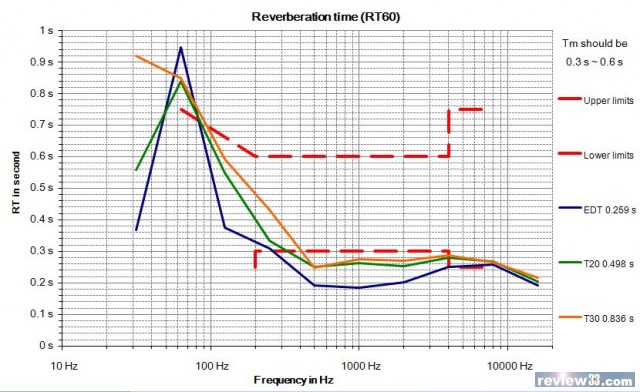 |
25908723 正式會員 203.xxx.xxx.50 |
2010-01-05 23:32 |